-
The joy of posting
Substack has no public API. That means that if you want to post anything there, you must use the main Substack site. Third-party text editors such as MarsEdit don’t work.1
Thinking outside the browser
That’s bad news for me because I’ve never liked writing big, long posts in a browser tab:
- There’s a lot going on in any browser session—maybe I have ESPN open, alongside YouTube, plus online banking. Distraction is millimeters away. Safari isn’t a writing tool so much as an everything-tool. And a lot of those things are more low-friction than writing.
- Though less of an issue than in the past, browsers sometimes reload the page and force you to reset or switch your context. Re-authentication is needed if history is cleared, too.
- They use a lot of memory, and their overall relatively sluggish performance means they don’t offer as rich and swift a writing environment as a dedicated desktop or mobile app.
This may sound like a relatively minor gripe, but it grated because it felt like I wasn’t getting the most out of my Mac, which has numerous great options for writing and publishing outside the browser.
Struggling with Substack
Moreover, Substack doesn’t just make you use the browser—it requires you to spend a lot of time there. That’s because the email newsletter format puts pressure on every post: It needs to feel worthy of being thrust into the inbox of your subscriber list, or demanding their attention. You can’t just microblog “Lunch (get lunchin’)2” and send it to your list.
If it’s not something meticulous about the Federal Reserve, a lengthy mailbag from a contrarian opinion columnist, or an exhaustive Succession weekly roundup and character ranking3…why bother? You’ll almost certainly get no attention for it despite your effort.
Bridie Dillon captured this feeling succinctly on Medium:
The time I spent writing on Substack I didn’t necessarily enjoy, whereas, I love writing on Medium. The effort I put into every newsletter was incredibly high, for what felt like a very minimal result.
Posting wasn’t fun on Substack, so I won’t be posting there anymore4. But posting here is fun.
Low-stakes and taking Shortcuts
When I began this blog, I did so with the intention that:
- I’d post whenever I felt like and not when it felt like my email list deserved to get something.
- I’d write somewhere other than the browser, for better focus and performance.
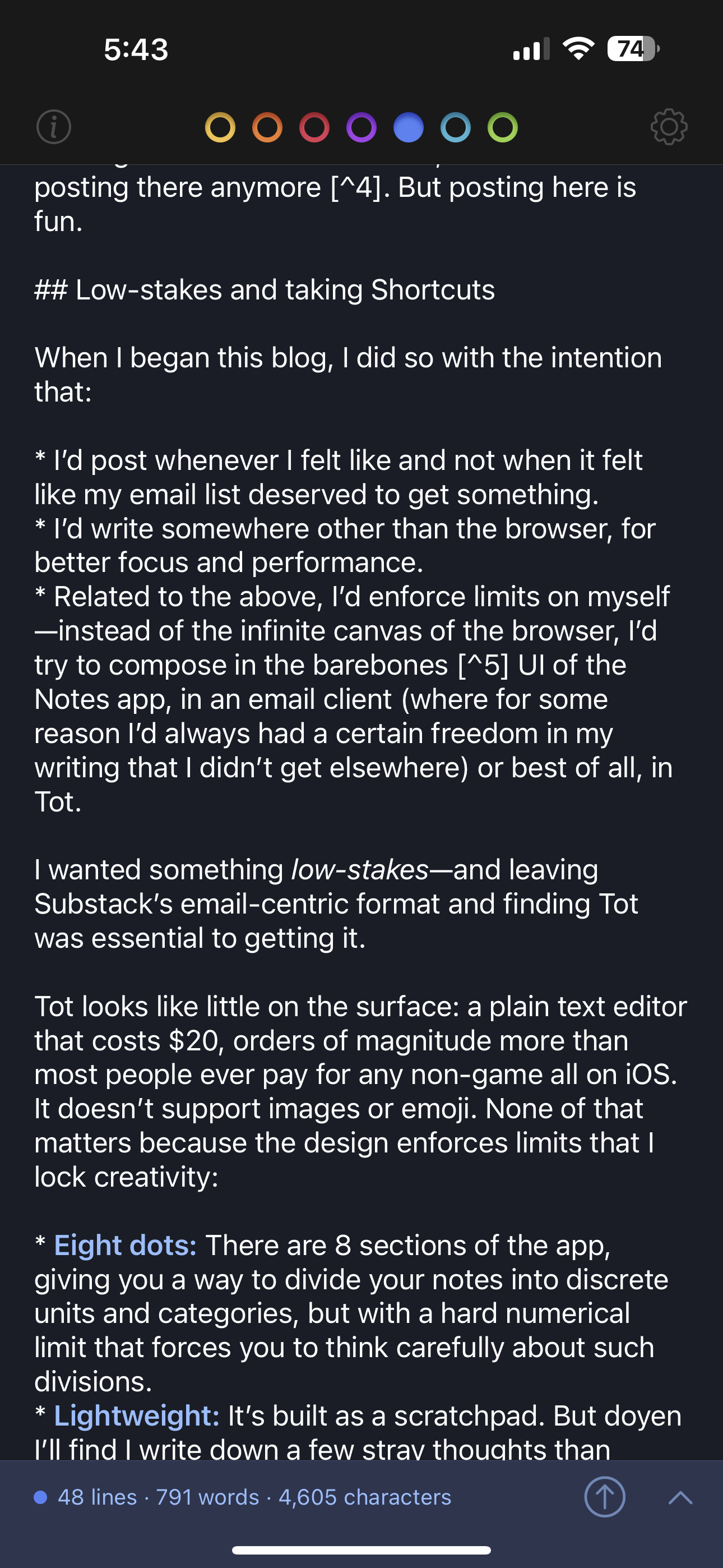
- Related to the above, I’d enforce limits on myself—instead of the infinite canvas of the browser, I’d try to compose in the barebones5 UI of the Notes app, in an email client (where for some reason I’d always had a certain freedom in my writing that I didn’t get elsewhere) or best of all, in Tot.
I wanted something low-stakes—and leaving Substack’s email-centric format and finding Tot was essential to getting it.
Tot looks like little on the surface: a plain text editor that costs $20, orders of magnitude more than most people ever pay for any non-game on iOS. It doesn’t support images or emoji. None of that matters because the design enforces limits that unlock creativity:
- Eight dots: There are 8 sections of the app, giving you a way to divide your notes into discrete units and categories, but with a hard numerical limit that forces you to think carefully about such divisions.
- Lightweight: It’s built as a scratchpad. But often I’ll find I write down a few stray thoughts that then evolve quickly into a full-blown blog, in a way that I would never do with a browser or Word or Pages, where whenever I open them I feel like I’m beginning a big paralyzing Writing Ritual rather than just…writing. And when it does morph into a full blown blog, the next two features become invaluable.
- Markdown: Tot automatically applies bold and italic Markdown styling when you use those buttons, plus it supports other Markdown syntax such as linking with a combination of brackets and parentheses.
- Shortcuts: Each Tot dot can be queried through an iOS or macOS Shortcut, meaning you can get that Markdown text and easily send it to a service like Wordpress, Tumblr, or Micro.blog, where it’ll render as gorgeous HTML. So a Shortcut that links Tot to one of these landforms means you‘ve basically got a minimalist dedicated publishing app like MarsEdit on your phone!
Publishing through a Shortcut and seeing all that Markdown text get transformed is fun. It’s hard to explain exactly, but it makes me realize how having nice tools—Tot, Markdown, MarsEdit, Micro.blog—is often as important as having exciting ideas when to comes to regularly blogging.
-
MarsEdit can publish to Micro.blog, Tumblr, and others from the desktop. It also has a global keyboard shortcut that lets you “micro post.” ↩︎
-
I love these types of 2006-esque blog entries from pros like Atrios. ↩︎
-
What I found fascinating about prestige Succession #content was how closely it resembled circa 2009 ESPN articles, such as power rankings of college football teams and reader question mailbags. ↩︎
-
However, my podcast still goes through there on the backend. ↩︎
-
BBEdit, the Mac’s quintessential text editor, began as a “barebones” project that eventually became a sophisticated tool—there’s a lesson there in starting simple and iterating from there, instead of trying to build a masterpiece from scratch. ↩︎
-
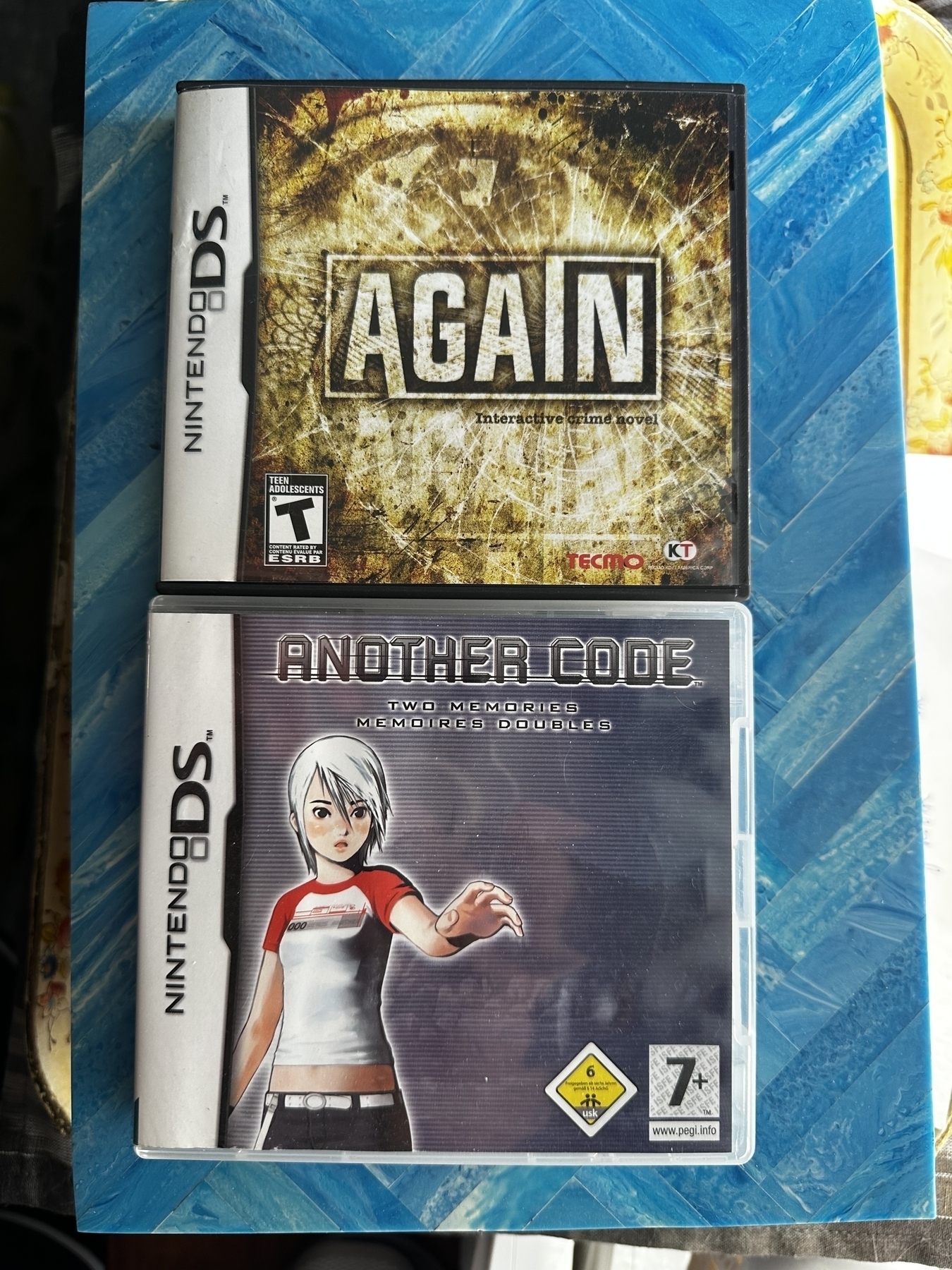
The Nintendo DS was a haven for point-and-click adventure games:
- Again even featured full-motion video a la a mid-90s Sierra game
- Another Code makes creative use of the DS hardware
These games are from different regions; the DS was region-free.
-
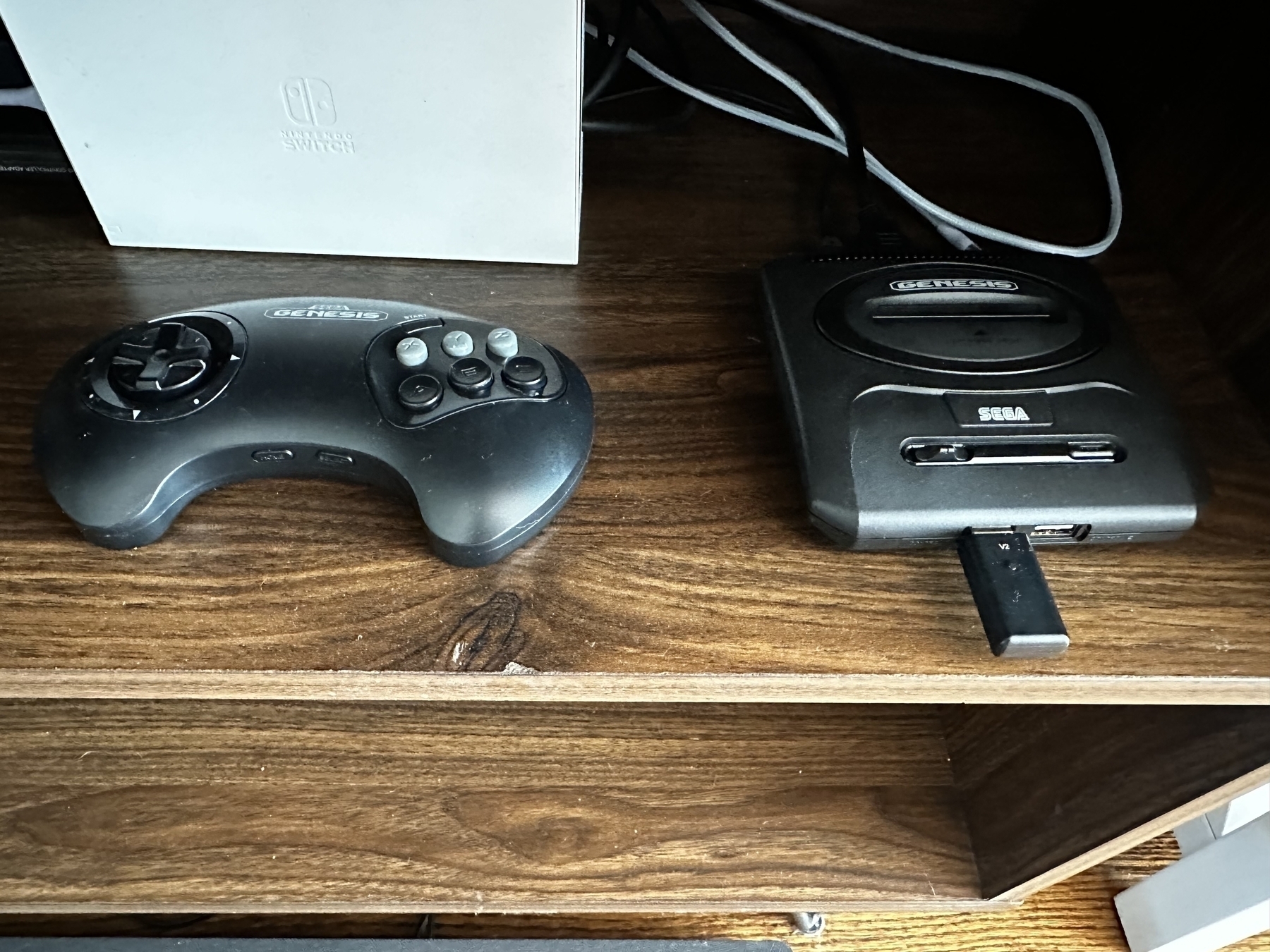
Circa 1996, I needed a lot of thick proprietary cords and power supplies to run all the games on this machine (a Genesis plus a Sega CD). This one just plugs into the TV USB port.
-
Hollywood killed two and almost three super reliable cash cows—cable TV, DVDs, and theaters—because elder millennials binged House of Cards on their overheating 2013 laptops.
-
Bird on a wire

-
Living in the age of captions and subtitles
Closed captioning for TV is relatively ancient technology. The NTSC analog TV specification, released in the 1950s, allows TV-decodeable captions on line 21 1. These captions are the same ones used by VHS tapes and some DVDs 2.
About a decade ago, I learned that these analog captions—which aren’t in the same format as the digital ones you see on streaming shows, Blu-ray-ray Discs, or even more recent-vintage DVDs—at the time required a composite cable input, when being sent from an external source device such as a VCR or optical disc player to a TV. A set of DVDs I had emblazoned with the “CC” logo wouldn’t show any text via HDMI or component cables 3, but would via composite.
But recent players, such as a Panasonic 4K UHD player I got in 2020, can render analog captions on-device and pass them to the TV over HDMI 4. I’m grateful for this functionality, and for captions and subtitles more broadly, because they exemplify accessibility at its best.
Accessibility
Although designed to assist people with hearing issues or who could otherwise not listen to or comprehend the speech in a show, captions provide a richer experience for everyone:
- They serve as an escape hatch from whisper-quiet speech that can’t be turned up without risking getting your ears blown out by a huge on-screen explosion in the next scene.
- They’re the only way to engage with dialogue in languages you don’t know, or that’s delivered in accents or cadences you can’t grasp.
- They often offer descriptions that are colorful, humorous, informative, or artistic on their own terms; for example, a caption I once saw that read “a la De Niro” right before someone did an impression, or any of the art-in-themselves subtitles on Stranger Things, a show whose writers are deeply attentive to how they style their subtitles:
There’s the scene where Henry/Vecna/001 is creating the Mind Flayer. I remember listening to the sound design and it reminded me a lot of the sound design of Arrival. The atonality is meant to get at an alien harshness, so one of the tags I used — and I chose this word because Karli and I wanted to go big; we wanted to bring our A-game — was “[unearthly susurration]”. I chose “susurration” because it’s an alien word that automatically makes you go, Oh, this is unusual, strange, and eerie. But also, I liked the fictive sense of it, like when you say “susurration,” it feels like it’s scraping the inside of your ears. Karli thought it was great but said, “Let’s have ‘unearthly’ do the heavy lifting here. This is a bit much.” And she was dead right!
We always leave captions or subtitles on because our household includes people and visitors who don’t speak English as their first language. The text is invaluable to them.
Reading TV
But others see this text as distracting and even damaging to the aesthetic vision of a show. Writing for The Atlantic, Devon Gordon chronicled an internal monologue he had at seeing everyone around him putting on subtitles for everything:
Because now I’m reading TV, not watching it. Because now, instead of focusing my attention on the performances, the costumes, the cinematography, the painstakingly mixed sound, and how it all works together to tell a story and transport me into an alternate world, my eyes keep getting yanked downward to read words I can already hear. My soul can’t bear the notion of someone watching The Sopranos for the first time and, as Tony wades into the pool, looking down to the bottom of the screen to read [ducks quack]. Subtitles serve an important purpose for people with hearing or cognitive impairments, or for translation from a foreign language. They’re not for fluent English speakers watching something in fluent English.
TV is a visual medium that conveys most of its details in ways other than text. But it’s also, as Gordon adeptly describes, under pressure from sound mixes that bury dialogue. Text offers a comforting way to literally turn down the volume.
And then there’s the issue of “second screens,” 5 that is phones, which draw people’s attention away from the show on the larger screen. Aren’t subtitles, with all their descriptive detail begging to be parsed as in Stranger Things, a way of fighting back against this multitasking?
I’ll keep leaving the captions and subtitles, for this reason and all the others described here.
-
NTSC was designed for interlaced video on CRT TVs, with the picture consisting of individual scan lines. ↩︎
-
Shows like the 1987 TMNT animated series were natively shown on NTSC television with line 21 captions. These captions were preserved on both the VHS tapes and the DVDs made from the scans of those tapes (you can still see the scan lines in the DVD copies when a progressive scan display de-interlaces them ). ↩︎
-
Component video uses three cables instead of the single one in composite, plus it supports progressive scan (composite only supports interlaced scan). ↩︎
-
4K disc players can only output video via HDMI; composite and component inputs aren’t provided. ↩︎
-
Really, they’re more like the “first screen.” ↩︎
-
Why “content creator” is such a bad term:
Union shops such as the Directors Guild have long fought for proper credits recognition, and creator touches a specific, raw nerve. It is imbued with the baggage of the internet and, specifically, a subset of workers whose work is frequently devalued by, exploited by, and subject to the whims of capricious technology platforms. Many creators work on volume, constantly churning out content to make money and stay relevant. The moniker itself, as WGA West President Meredith Stiehm made clear in a statement, is “diminishing.”
-
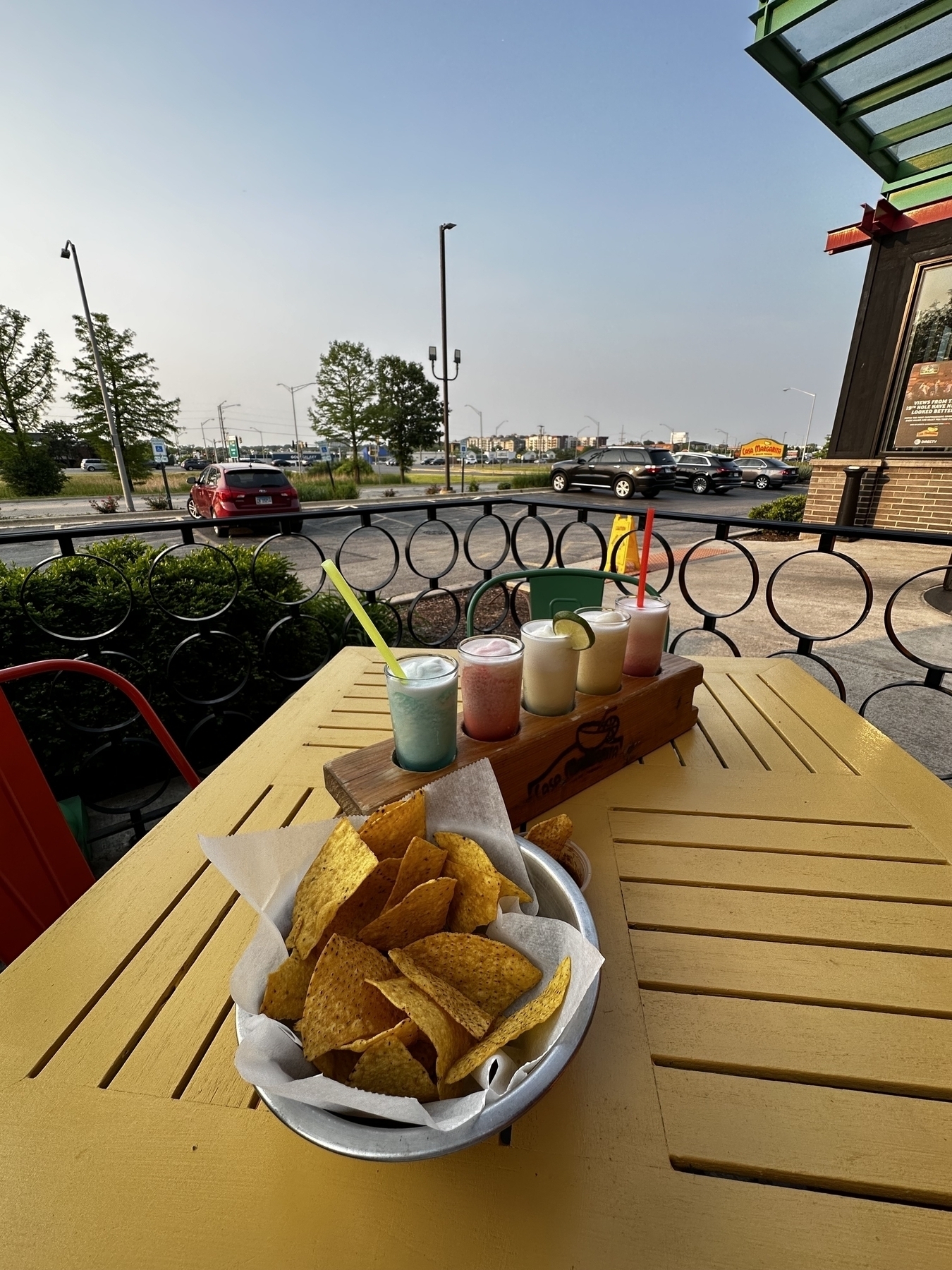
Drinking some really yummy margaritas next to the interstate feeder road 🍹🚗
-
The magic cloud computing button
When I worked for a content marketing agency 1, we added Shutterstock photos to our lightly rewritten “news” articles. Some were generic people shots, but a big chunk were these “magic cloud button” ones. I always wondered what the button would do:
- Open a Confluence Cloud 2 page?
- Run Speedtest.net?
- Open Dropbox or Google Drive?
I got so used to writing this “cloudy” content 3 that I could churn it out without even thinking—which was probably the point of my training there. Implicit in calling anything “content” is thinking that it should be, if not literally made by a machine, then produced with the speed and unsentimentality of one.
I wrote a variant of the following hundreds of times
Cloud computing solutions let small and medium sized businesses 4 access pooled compute, storage, and networking resources over an IP network. Compared to on-premises IT infrastructure, cloud computing is more cost-effective and scalable.5
I may as well have had a TextExpander (which I still used for my personal projects at the time) entry for that. I was becoming a machine writing for other machines.
Now that type of writing is post-cliché—commoditized even more by ChatGPT et al. Maybe the magic cloud button was always meant to be a one-click solution to creating some clickable content.

-
Some would use the more derisive terms “content mill” or “content farm.” ↩︎
-
What an awful product, worse than its on-prem/server version in almost every way. ↩︎
-
This word classifies whatever’s being created as basically interchangeable with anything else—it’s there to fill up the container (a Google SERP page in this case) and do nothing else. ↩︎
-
All content is nominally aimed at SMBs. ↩︎
-
Not always true, because cloud services are perpetual subscriptions. ↩︎
-
Most important WWDC for Apple since the 1990 one that featured a VHS tape with a conference walkaround and a HyperCard stack that cataloged all the attendees.
-
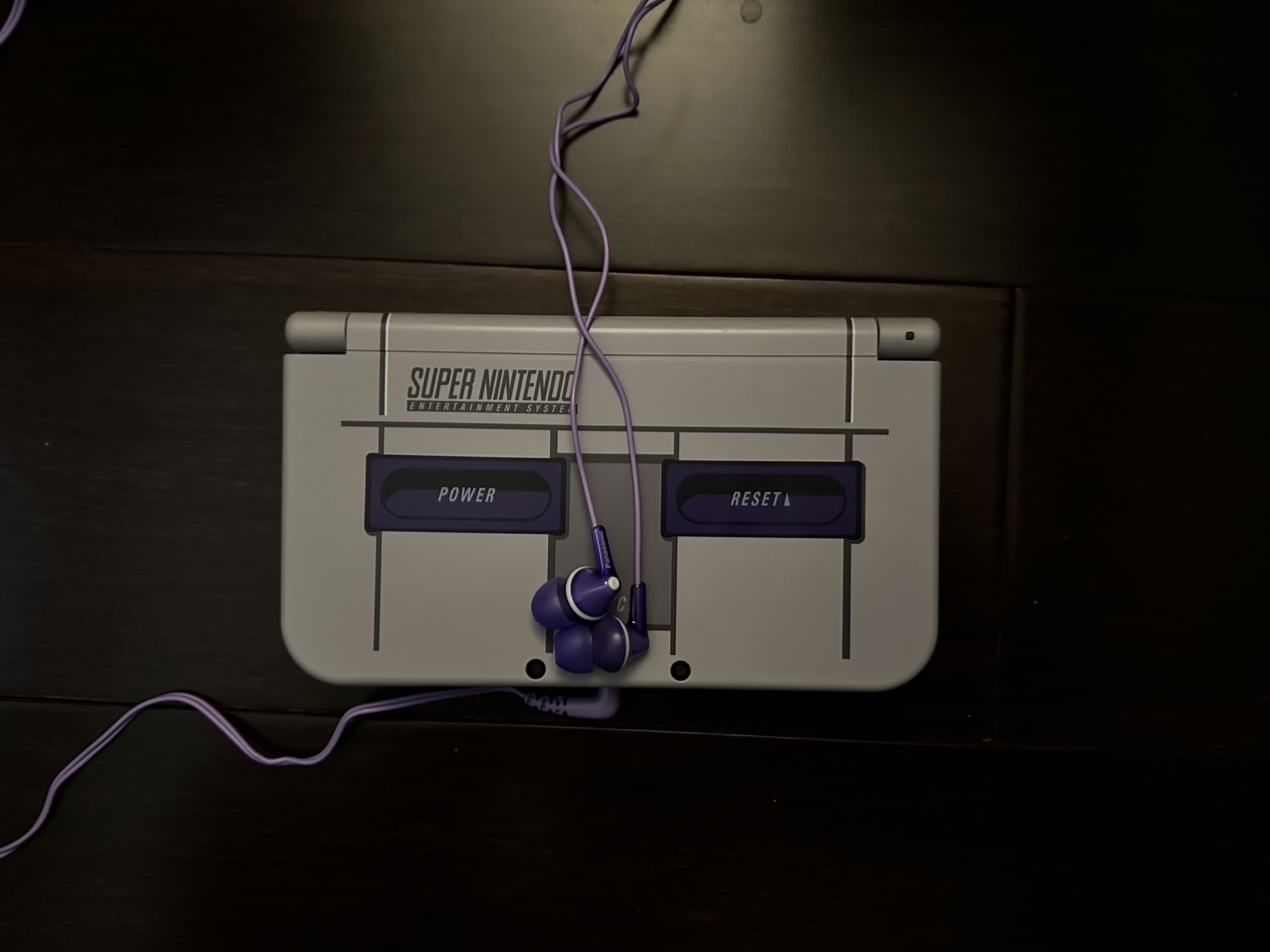
SNES edition of the New Nintendo 3DS XL, with purple Panasonic earbuds whose purple hue matches the mock Power and Reset buttons almost exactly. User-replaceable Li-ion battery; I have three in reserve, you know, just in case.
-
The red queen has ruled
Out not having colorblindness
After seeing this scene and decreeing
It “Another green world”

-
Anything called “content” is in danger, b/c that term centers the platform owner—not the artist. And those owners will, say, remove a bunch of “original content” from their streaming service to reduce their tax bill. This is also why the decline of optical discs, with their quasi-permanence, is bad.
-
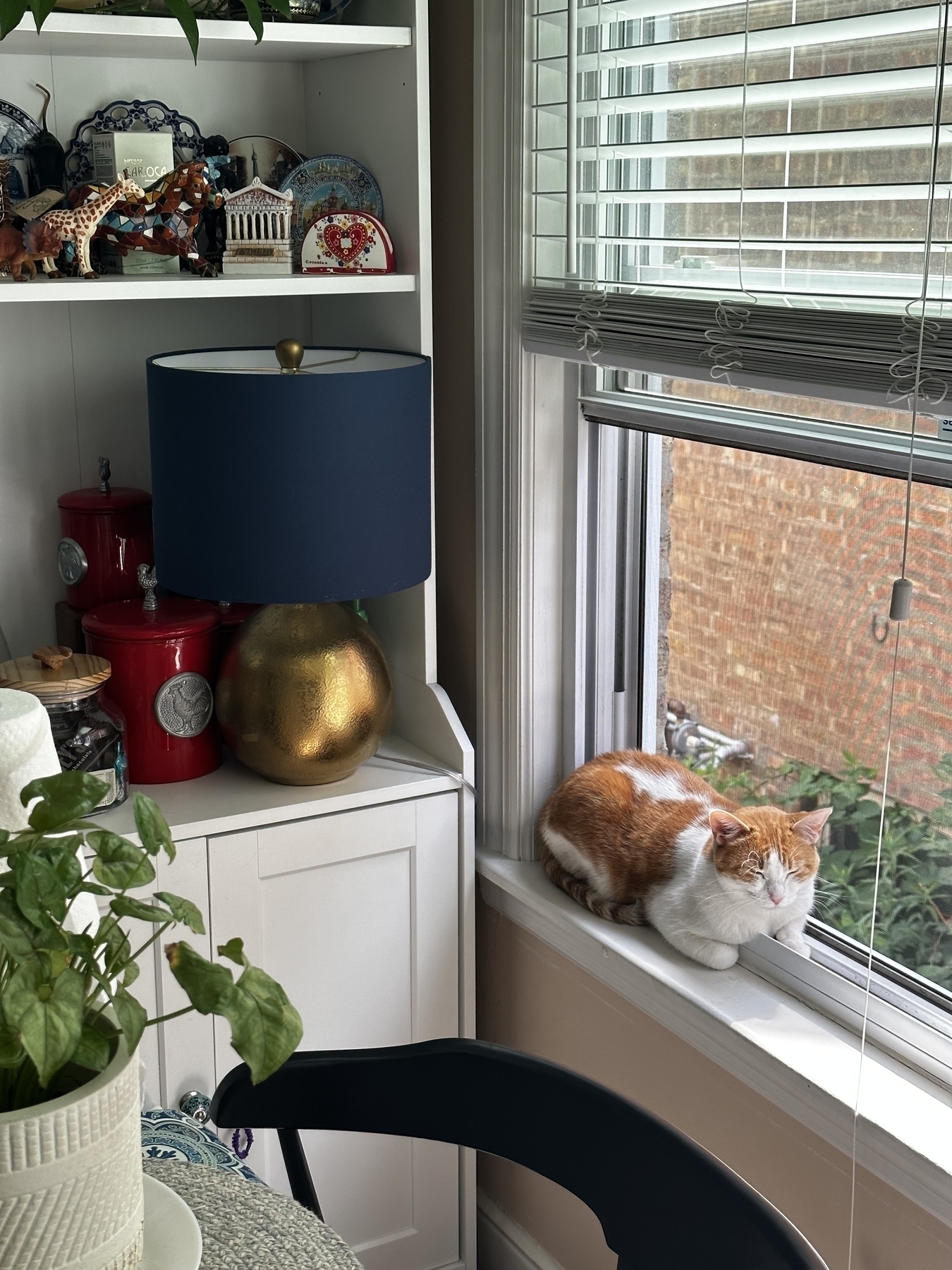
So much depends
On an orange cat
Brushed by breeze
By the also-orange bricks
-
Milkweed coming along nicely

-
Retreat? Retreat!
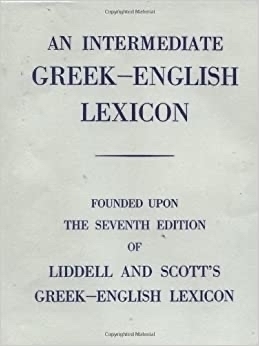
Attic Greek has two words with substantially different meanings that both translate into English as “love.” I won’t spoil the fun; look up their differences, as a little treat.
These types of word complexities reveal an overloadedness to certain English worlds, “free” being another great example 1. So in Greek class 19 years ago, we had a little fun with:
Dikaeopolis loved his pretty plow
Something milder is going on with the word “retreat” as often used by academics and Catholics 2 plus all-remote organizations.
There’s:
- Retreat (nay!): Giving up on your reply-all hell thread, marriage, and so on; painfully generating the grist you’ll need later on for your LinkedIn content mill that’ll become a staple of r/LinkedInLunatics
- Retreat (yay!): Having a long but catered and relatively fun meeting, performing a chill religious ritual, or finally meeting up with the person you’ve only ever seen say “sorry there’s an echo” on Microsoft Teams to have beer 3.
The difference is nicely cleft depending on whether “retreat” is used as a verb (nay!) or a noun (yay!).
But there’s also a “nay/yay” one that straddles these lines for Catholics in particular, I imagine.
The Catholic Church is known for its extreme anti-birth control stance. So someone who’s having presumably a good time but who’s also weirdly orthodox in their views and likes to court some risk could find themselves needing to…beat a retreat, or go on a retreat to stay faithful.
Maybe the plow could help them out?
-
Think “free as in beer” vs “free as in speech,” which necessitated the evolution of Free and Open Source Software (FOSS) into Free/Libre and Open Source Software. This issue doesn’t exist in Spanish, which has gratis and libre to differentiate these concepts. ↩︎
-
And academic Catholics?—they’re just perpetually, immaculately retreating. ↩︎
-
Teams is one of the worst macOS apps I’ve ever used. A total energy hog that’s almost always the “reason” in “you’re breaking up for some reason.” ↩︎
-
When you call everything content you treat it as:
- interchangeable
- capable of being made by a machine
- beholden to the container owner
The name of this blog sprung from the (badly mistaken) idea that everything can just be formulaically brewed up in a lab. You can make drivel that way, but not art.
-
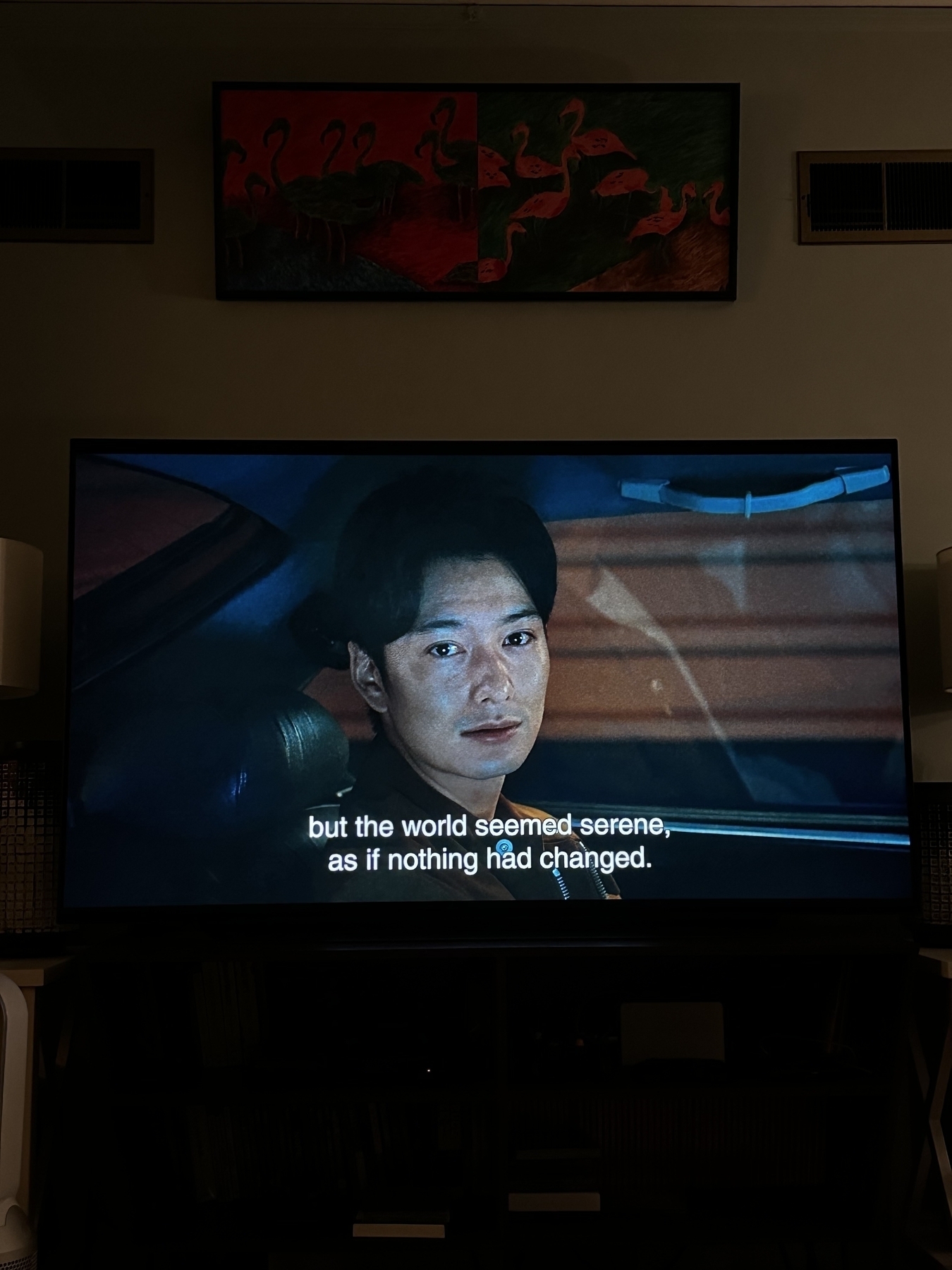
Drive My Car was exceptional—my favorite movie of the 2020s so far.